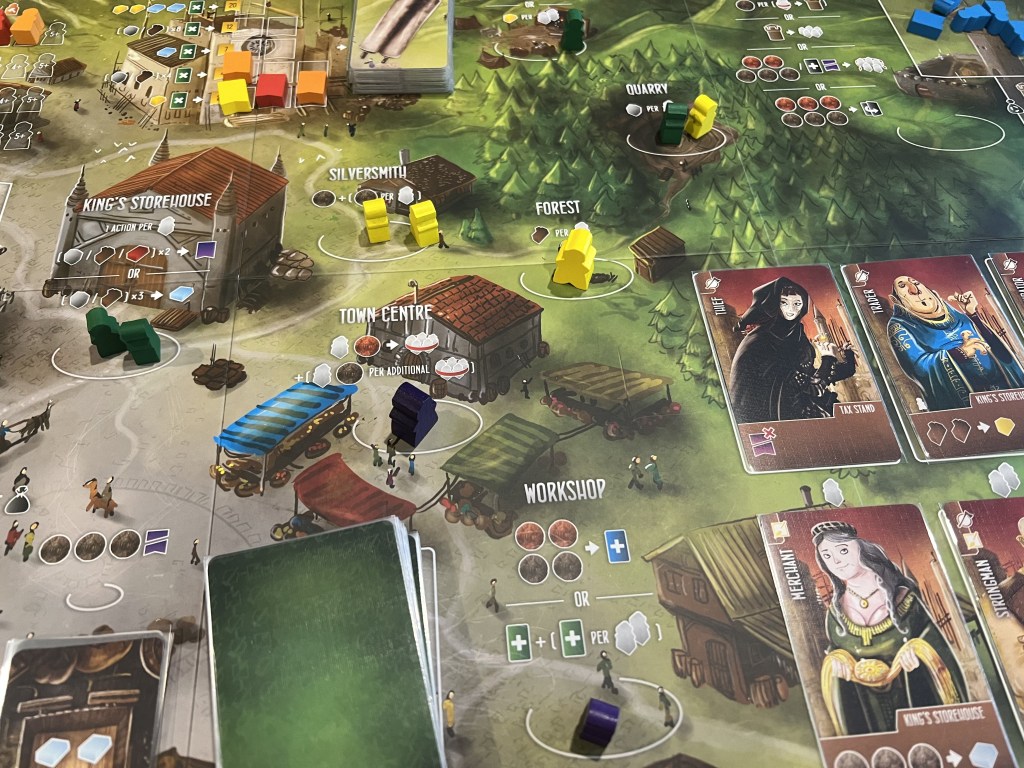
	Another review of another Garphill game.  This time, it is Legacy of Yu.  Legacy of Yu is a solo, campaign game.  If you have read my reviews of other Garphill games, you will know that I think the solo modes for their multiplayer games are top notch.  Legacy of Yu plays very much like the solo mode of one of these games - and very unlike their other solo game, Hadrian’s Wall, which is a roll-and-write.

	In Legacy of Yu, the player is trying to build canals along the Yellow River in ancient China to prevent floods from devastating the countryside.  Build six canals, you win.  If the flood gets to an area with no canals, you lose.  If you are overwhelmed by barbarians, you lose.  If all of your townsfolk are killed, you lose.  Win seven games, you win the campaign.  Lose seven games, you lose the campaign.  Sounds simple.

	The game really is not that complex, at least from the rules.  Those familiar with Garphill games already know most of the rules.  Collect resources (harvest) at the beginning of a round.  Build buildings that give you immediate effects and on-going benefits.  Place workers for immediate effects.  Buy multiuse townsfolk cards.  Tuck townsfolk cards under the board for on-going benefits.  Those are all familiar Garphill mechanisms.

	The two main things that the player has to worry about are the flood and the barbarians.  Whenever the player runs out of available townsfolk cards and has to reshuffle, the flood moves down the river one section.  If the player has not built canals in that section, the player loses the game.  Relative to other actions in the game, especially fighting barbarians, building canals does not cost many resources.  The player just has to avoid forgetting to do so in a timely manner.

	The biggest problem for me in my first playthrough was the barbarians.  To defeat a barbarian, the player needs to return three workers of specific colors to the main supply.  As with Shipwrights - Redux, returning workers to the main supply removes them from the player’s personal pool.  Legacy of Yu only has a couple of ways of carrying workers over from round to round.  This makes fighting barbarians in the early game very difficult.  Not only does the player have to get workers, they have to be of the right colors.  Early in the game, the player only get colored workers (as opposed to white workers, which cannot fight barbarians) by discarding townsfolk cards for their resources.  The player only gets four townsfolk per round.  Townsfolk resources can be brick, wood, shells, or provisions, in addition to workers.  Being able to defeat a barbarian before three or four are on the board would be lucky.  Later in the game, the player can get workers of colors of their choosing during harvest, as well as getting the power to be able to treat workers of one color as workers of another color.

	In my first game, I lost to the barbarians.  I had built three of six canal sections, one of three farms, two of four outposts, and one of four huts.  I had recruited the vast majority of townsfolk.  My engine had started to come on-line.  Then, I lost to the barbarians.

	As with most Garphill games, at least their solo modes, the game is basically a resource management game.  The player has to get the right resources to do what they have to do immediately, as well as preparing for what they have to do in the future.  A balance of tactics and strategy.  Building farms gets the player more resources each turn during harvest.  Building outposts make workers interchangeable.  Building huts give worker placement spots for workers that can be reused each turn.  In different ways, different buildings help battle the barbarians.  A key strategy is in which order to build.
	Tactical decisions include whether to build a canal section this round or put it off, whether to bribe barbarians with resources or have them carry off a townsfolk card, and which resource trades to make to achieve this round’s goals.  Deciding whether to bribe barbarians is the trickiest of these decisions.  The flood advances whenever the player has to shuffle the townsfolk deck.  Whether that will occur this round can be calculated.  Bribing a barbarian can use up resources that would be handy next round.  But burning a townsfolk card brings the flood sooner.
	In my first game, I found a couple of issues with the game, both regarding the availability of resources.  Since it was my first game, it is possible (likely) that there was a rule I missed or misinterpreted.  I found provisions very easy to acquire.  As far as I could tell, provisions are only used to buy townsfolk cards.  Legacy of Yu uses a river system.  The leftmost card in the river costs nothing.  The next two cost one provision each.  The next two cost two provisions each.  A player gets a provision every harvest.  Provisions are also common resources that can be gotten from exhausting townsfolk cards.  (The difference between discarding and exhausting townsfolk cards is a key distinction.  It is easy to get them confused.  That is one of the problems I have with the rulebook.)  The player can, therefore, recruit  at least two townsfolk every round and usually three or four.  At the end of the game, I had twenty-one cards in my deck, eight cards not in my deck.  Since the flood only comes when the player has to reshuffle their townsfolk deck, I had several rounds between needing to build canal segments.

	The other resource issue was a dearth of brick.  Building needs brick and wood.  Partially because I chose to tuck a townsfolk card early on that got me wood every round, I found it much easier to get wood than brick.  Part of the problem was luck.  I did not recruit townsfolk that could provide me with brick until well into the game.  I suspect that the game is balanced so that it is hard to get either brick or wood (or both) early in the game.  If that is the case, then I do not have a problem with it.  Getting brick was just frustrating in my game.

	My only other complaint is a quibble with rulebook design.  The rulebook provides illustrations giving examples of the rules.  The problem is that the board in the illustrations is very busy.  It is hard to find the part of the board that shows off the rule.  Other rulebooks provide numbers, outlines, arrows, or some other visual cue linking the text with the illustration.  That is an easy thing to add that would have made figuring out some rules much simpler.

	The components are good.  Workers, brick, and wood are wooden pieces.  Shells and provisions are cardboard.  I suspect that this is because the manufacturer already had tooling to make workers, bricks, and wood.  These are bits used in other Garphill games.  The shell and provisions are unique to Legacy of Yu.  No complaints about the difference.  It is just interesting.  The cards are decent.  I sleeved them to make shuffling small decks easier.  As with other Garphill games, the box is small, environmentally efficient and saving production and shipping costs.  Legacy of Yu does come with a plastic organizer insert.  I have complained about these in other reviews as being unnecessary, expensive, and non-recyclable.  In this case, including the insert is arguably necessary.  As a campaign game, cards which have been retired have to be clearly separated from those in use and those not yet in use.  The insert does that.  Are there better solutions?  Probably.  But, in this one case, I am not going to complain about the insert … too much.

	Overall, Legacy of Yu is a good game.  To me, it is less complicated than the solo modes for many other games.  It is still meaty enough to be satisfying.  The fact that is it a campaign game gives impetus to continue playing it.  Will I, when I have a bunch of other Garphill games, not to mention many other games by other publishers?  We will see.
 Den of the Red Wolf