First, I’d like to say that a Garphill game by Shem Phillips is the closest I get to an automatic crowdfunding pledge these days.  I have several reasons for this:

Garphill delivers quickly, usually about nine months after the end of their Kickstarter campaign closes.  They also deliver on-time, sometimes even early.  They don’t quite use Kickstarter as a pre-order system, as Queen Games does.  But the game design is complete by the time they start the campaign.  They only need to manufacture and ship it.  I just received Divinus 2 ½ years after its campaign closed and 7th Citadel after 3 ½.  7th Citadel was supposed to deliver almost 2 years ago.  I also got a notification that CoLab is about to ship - 2 years after the date of my late pledge.  Waiting that long has made me wonder why I bought them in the first place.

Their games are more environmentally positive than most.  Their boxes are small.  Their components are wood, paper, and cardboard.  (Although Shipwrights does have a plastic organizer.)  They minimize the use of materials, and those they do use are mostly recyclable.  The smaller size also allows them to ship more in a single container, reducing shipping costs and shipping fuel.  They haven’t quite achieved a product as environmentally friendly as Earthborne Rangers, but they are better than most.

Most importantly to me, they have good solo modes.  Some games have such complicated AIs that it takes more effort to run the AI than to play your own game (Scythe).  Many others simplify the game and cut out significant gameplay (Clans of Caledonia).  Neither approach sparks joy.  Shem’s games usually have AIs that are simple to run but hard to beat.

Shem’s games are also usually good multiplayer games.  Raiders of the North Sea and Architects of the West Kingdom are currently hanging around #100 on BoardGameGeek (BGG).  Paladins of the West Kingdom is higher than that.  Designing three of the top 100 or so best games of all time is a pretty good record.  Both Raiders and Architects should be in the collection of any fan of mid-weight Eurogames.

Shipwrights of the North Sea was Garphill’s first Kickstarted game.  It is also considered one of its worst (score of 6.4 and a ranking of 3,662 on BGG).  Shipwrights of the North Sea - Redux is a redesign of that game.  I’ve never played the original, so I cannot compare them.  I understand that the new version is closer to a whole new game than a tweak of the original.

In Shipwrights, you are a Norseman or Norsewoman building longships.  (Presumably, those longships will be used to go raiding in Raiders of the North Sea.)  You are helped in this endeavor by buildings you build and crafters, townspeople, and Jarls that you recruit.

The game’s primary mechanism is resource management.  You need workers, wood, stone, and wool to build both buildings and longships.  You also need specific crafting skills in your tableau to build a longship.

The game has two secondary mechanisms.  Cobbling together some sort of resource producing engine is a necessity in order to build more than a couple longships in the five rounds the game lasts.  Doing so in time to make much of a difference is one of the key challenges of the game.

The final mechanism is worker placement.  It wouldn’t be a Shem Phillips game without some sort of worker placement.  In Shipwrights, this mechanism is much less important than in his other games.  The only worker placement spots are on the player boards and in a player’s tableau.  There is no competition for these spots.

Each round, the players get a new hand of Village cards.  These cards are multi-use.  Any of them can be discarded to get a resource.  Crafters and townsfolk can have one-shot effects or can be tucked under a building for a continuing benefit.  Tucking a card costs a gold, though.  Gold is a special resource harder to get than the others.  Jarls have to be tucked.

Buildings cost resources to build.  They provide worker placement slots and can provide Victory Points (VP).  Building a longboat requires resources, usually a lot of resources, and skills provided by crafters.  They are the main source of VP.  They also provide either an immediate benefit, income collected each round, or extra VP if certain conditions are met at the end of the game.

Any card can move a player up one or more of the three progress tracks.  Being the farthest up one of these tracks gives a player access to a “hero”, a card with a special power.  Getting to certain milestones on each track also provides benefits.  The military track, for example, provides players with raid cards.  A player can use one of these cards to trade workers for resources once per round.

A negative for this game is that nothing about it seems new.  Most Garphill games either add a new mechanism to their stable or rework one they have used before in a way that makes it seem new.  The Shipwrights mechanism of requiring both resources and specific craft skills to build something is straight out of Architects.  I haven’t gotten out all of my Garphill games to compare their mechanisms, but tucking cards and the use of hero cards to provide special powers seem very familiar.

On the positive side, this might be the Garphill game most approachable to those new to Eurogames or hobby games in general.  I think the rules are the simplest to understand.  One of the two player interactions is drafting of the Village cards at the beginning of each round.  My solo playthrough obviously did not involve drafting, so I cannot comment on how important or cutthroat drafting is.  The other player interaction is the race up the three progress tracks.  The hero’s powers are not so critical that this race is a major focus of the game.  Shipwright players are almost playing their own solo games.  This gives new players room to think about what they are doing without the pressure of direct competition.

Being a simple game does not mean that it is an easy game.  The resource management puzzle is quite challenging.  A player needs to build several longships to be successful.  Those longships need a lot of resources to build.  The player needs to build up an income stream and resource generation engine to get those resources.  For that engine, the player needs to build buildings and tuck villagers under those buildings.  All of that also costs resources.  And the game is only five rounds.  Based on my playthrough, a solo player would have to build at least five longships to beat the AI.  That is a big ask.

A game of Shipwrights is relatively quick for a mid-weight Eurogame.  My first playthrough took 75 minutes, including setup and takedown.  Under an hour of actual play time.  I took some time the first couple of rounds reading the rulebook so I did not miss a rule.  I wouldn’t think a single, solo playthrough could get down to 30 minutes, not including setup and takedown.  Under 45 is certainly doable.  The mostly independent play for multiplayer means that players can take their turns at the same time.  A four player game would not be hugely longer than a solo playthrough.

The components are good quality.  The resources and workers are wood.  The coins are cardboard, but I have metal coins purchased for other Garphill games that I can use.  The cardboard boards are sufficiently thick and sturdy.  The cards are good quality.  I sleeved them mainly to make the very small and very large decks easier to shuffle.

The rulebook is as clear and laid out as well as any.  I do wish Garphill had included player reference cards.  There are ten types of actions a player can take during their turn.  A solo player can keep the rulebook in front of them open to the list of actions.  Having cards listing those actions would be very useful in multiplayer games.

The plastic insert is better designed than most, in that it is obvious where all the pieces go.  It is, as I’ve mentioned before, far from necessary.  There just aren’t that many pieces to keep track of.

Finally, Garphill offers a free Google and iOS app to help in scoring.  It certainly makes scoring easier.  A pad of paper would have been just as good and would not be subject to disappearing with an OS upgrade if Garphill decides not to maintain it any more.

I definitely enjoyed my first play.  I find many first plays a struggle as I learn the rules, at least for the first few rounds of play.  I also often miss or forget a rule.  I did not have either problem with Shipwrights.

Not that I did well.  I think I played fairly efficiently.  I ended up with only two leftover resources and one leftover coin.  I built three buildings and three longships.  I did not get very far on any of the progress tracks.  My final score was just over half that of the AI.

I am no stranger either to resource management games nor to engine builders.  By the last round, I felt I had developed a productive engine.  I could only really take advantage of it for that one round.  Of the six Village cards I got each round, I generally played two.  The others I had to discard to get the resources I needed to play those two.  I certainly see ways to improve my play but not to double my score!  As long as you are someone who enjoys puzzles like this, Shipwrights has a lot of replay potential.  (In contrast, I also did poorly in my first playthrough of Atlantis Rising.  But I think that five or six playthroughs would be enough to “solve” the Atlantis Rising puzzle.)

I’ll keep Shipwrights - Redux in my collection.  I’ll pull it out as an intro to hobby gaming game.  For experienced hobby gamers, I’d reach for one of Shem’s other games.  For solo play, I’d usually also go for one of the other games, unless I was in the mood for one that was fairly quick and did not take much effort to relearn.
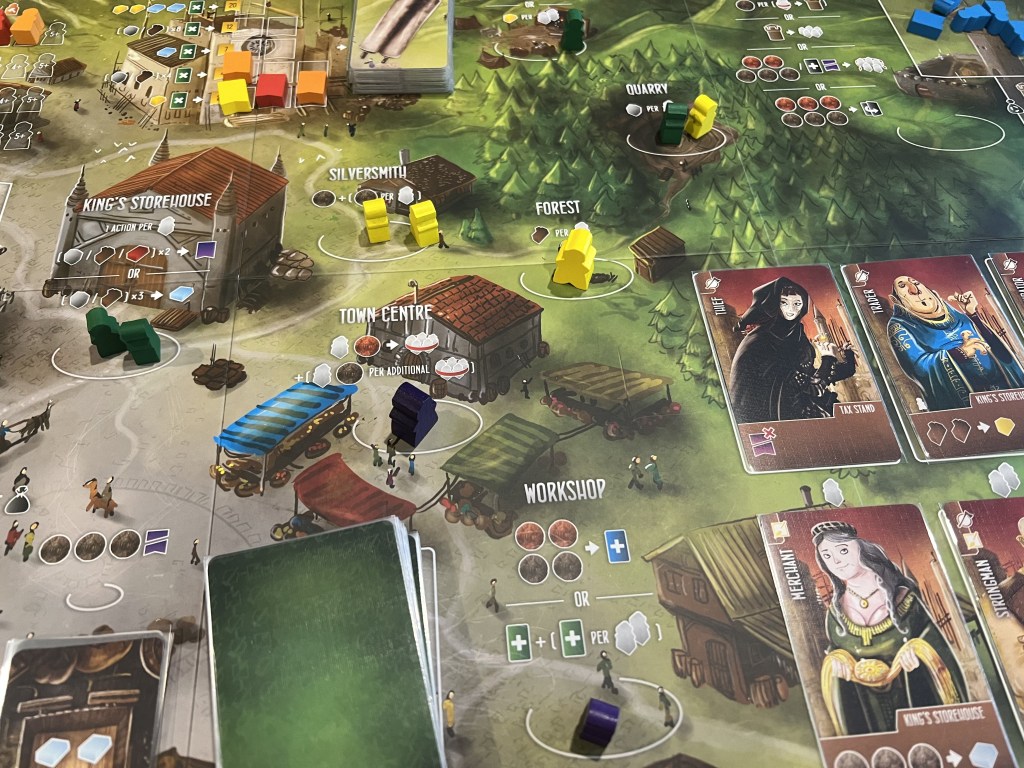
 Den of the Red Wolf