In my study of the life of King Arthur as depicted in various literary sources of the Matter of Britain, I will avoid just summarizing the content of those sources.  Instead, I will focus on comparing how each depicts Arthur in six categories:  his birth, his accession to the kingship, his wars, his arms and armor, Camelot and the Round Table, and his death.  As the series progresses, I will chart how the characterisation of Arthur changes from Geoffrey of Monmouth to Sir Thomas Malory.

For Arthur’s battles, I will also compare those reported in each piece to those reported in Historia Brittonum, a pseudohistorical description of the founding of England written about 828 CE.  Historia Brittonum is one of the first documents to provide details on Arthur, although it describes him as a dux bellorum or “war leader” rather than king.  Historia Brittonum ascribes twelve battles to Arthur, most of whose locations are at best a matter of speculation.  The first battle occurred at the mouth of the river Glein.  The next four were on the river Dubglas near Lincoln.  The sixth was on the river Bassas.  The seventh was fought in the forest of Celidon, which is probably the Caledonian Forest in the Southern Highlands of Scotland.  The eighth battle was at the fortress of Guinnion.  In this battle, Arthur carried the sign of the Virgin Mary on his shoulders and put the pagans to flight.  The ninth battle was waged at the City of the Legions, which is Caerleon in Wales, at least according to Geoffrey.  The tenth battle was fought on the river Tribuit; the eleventh on the mountain Agnet.  The final battle was at Mount Badon, which also appeared in De Excidio et Conquestu Britanniae, written in the early sixth century by the monk Gildas.  Unfortunately for fans of an historical Arthur, Gildas did not identify the leader of the Britons in that battle.  Badon is also mentioned in the tenth century Welsh chronology Annales Cambriae.  The Annales has the first mention of the battle of Camlann, “in which Arthur and Medraut fell.”

Historia Regum Britanniae by Geoffrey of Monmouth

The Historia is the undisputed parent of the body of literature known as the Matter of Britain, although its author, Geoffrey of Monmouth, drew on earlier sources.  These sources included the ninth century Historia Brittonum, Historia Anglorum written in 1129 CE by Henry of Huntingdon, and “a certain very ancient book written in the British language” which has never been identified, if it ever actually existed.  The Historia establishes important Arthurian themes, such his being the King of the Britons, his suffering mortal wounds in battle with Mordred, and his retreat to the isle of Avalon.

Geoffrey himself was a monk who lived in the early 12th century CE.  Other details of his life are known more from deduction and inference than from direct documentation.  He may have been born in Monmouth in Wales and served for a time in a Benedictine Priory there.  It seems that he probably spent most of his career in and around Oxford.

There is evidence that Geoffrey was a descendant of Bretons brought to Britain during the Norman conquest.  If so, his lineage provides an insight into the reason he wrote the Historia.  The work can be seen as a description of a British, Christian utopia being attacked by pagan Anglo-Saxons, Picts, and Scots.  These Anglo-Saxons would eventually drive many native Britons to Brittany.  These exiles would become the Bretons and Geoffrey’s ancestors.  In this light, the Norman invasion righted an ancient wrong.

The Birth of Arthur

Utherpendragon, King of the Britons,  was besotted with Ygerna, the most beautiful woman in Britain.  Unfortunately, Ygerna was the wife of Gorlois, Duke of Cornwall.  The desire to protect his wife from the King led Gorlois to insurrection.  The Duke and King assembled armies and formed up for a battle.

On the eve of the battle, Uther called Merlin before him.  Uther’s desire for Ygerna tormented him.  But the Duchess was secured in the nigh impregnable fortress of Tintagel.  What could Merlin do to alleviate the King’s suffering?

Merlin replied that he had drugs which could make the King look like the Duke and the King’s friend Ulfin like the Duke companion Jordan of Tintagel.  Uther agreed to the plan.  He, Ulfin, and Merlin infiltrated Tintagel as the Duke and his party.  That night Uther lay with Ygerna, and they conceived Arthur.

Even without their king, Uther’s forces won the battle and killed Gorlois.  Uther took Tintagel and Ygerna.  The two married and had two children, Arthur and Anna.  Anna would later be wed to Loth of Lodonesia (Lothian).  They would be the parents of Gawain and Mordred.

Later, more moralistic works of the Matter of Britain would attribute Mordred’s betrayal and Arthur’s death at least in part to the fact he was born out of wedlock.  Geoffrey never makes an issue of it.  After all, was not William the Conqueror, the warrior who freed Britain from the yoke of the Saxons, also called William the Bastard?

Accession to the Kingship

In the Historia, Arthur’s rise to the throne was fairly simple.  After his father Uther was poisoned by the Saxons in St. Albans, Dubricius, Archbishop of the City of the Legions (Caerleon), crowned Arthur on the advice of the leaders of the Britons.  No pulling a sword from the stone for Geoffrey.

Arthur’s Wars

Arthur was 15 when he became King.  Even at such a young age, he assumed the generalship of the British armies.  He immediately marched toward Saxon-held York.  He won a battle against the Saxon leader Colgrin at the River Douglas.  Colgin retreated to York.  Arthur besieged the city.  He was forced to give up the siege when Cheldoric arrived from Germany with 600 ships.  Arthur withdrew to London.

In the next phase of his war against the Saxons, Arthur marched to relieve Lincoln, besieged by the Saxons.  Arthur had been reinforced by his cousin, King Hoel of Brittany, with fifteen thousand armed men.  Arthur broke the siege of Lincoln and pursued the fleeing Saxons to the Caledon Wood.  Arthur cut down the wood and used the logs to build a wall around the Saxons.  Starving, the Saxons agreed to give their treasure to Arthur if he would allow them to sail back to Germany.  Arthur agreed, and the Saxons sailed away.

The perfidious Saxons quickly turned around.  They landed in Devon.  Shortly after, they laid siege to Bath.  The Saxons entrenched themselves on a hill near Bath.  Arthur climbed the hill with a shield bearing the likeness of the Virgin Mary.  He himself slew 470 Saxons.  The Britons, as always under Arthur, won the day.

Arthur then had to rush North to help Hoel against the Scots and Picts, who had besieged Hoel at Alclud.  Alclud may be Dumbarton Rock near Glasgow, or it might be an archaic name for Culloden.  In any case, it is likely to be well into Scotland, because Arthur next went to siege the Scots and Picts in Moray.  The Scots and Picts then fled to Loch Lomond.  Arthur set to starve them out.  Just at that time, Britain was invaded by the Irish in support of their Celtic brethren.  They did not stay long, as Arthur quickly cut them to pieces.  Arthur then returned to slaughtering the Scots.  He pardoned them after their bishops begged him to do so.

These battles in Scotland would be the last Arthur would fight until the betrayal of Mordred.  It also brings to a close the period of wars against the Saxons, Scots, and Picts described in the Historia Brittonum.  Some of the battles described by Geoffrey resemble some listed in the Historia Brittonum.  Geoffrey has a battle on the River Douglas, although it is near York, not the Dubglas near Lincoln.  Geoffrey does have a battle at Lincoln, followed by one at the Caledon Wood.  Geoffrey’s battle near Bath has Arthur bear the image of Mary, as he did at the fortress of Guinnon in the Historia Brittonum.  It is worth noting that the Annales Cambriae has Arthur bearing an image of the cross at the battle of Mount Badon.  This similarity with the description of Geoffrey’s battle at Bath, the similarity of the names Bath and Badon, and the fact that both the battles were the last one Arthur fought against the Saxons has led some to link Bath with Badon rather than Guinnon.  In any case, with the most liberal of interpretations, Geoffrey only describes four battles that can be equated with battles in the Historia Brittonum.

Arthur now settled in York for several months.  He restored his brother-in-law Loth to the Duchy of Lothian.  He married Guinevere, descended from a noble Roman family and brought up in the house of Duke Cador.

The next Summer, Arthur left on the first of three campaigns of foreign conquest.  In this campaign, he started in Ireland.  He easily defeated the Irish king, whose soldiers were unarmored.  After the defeat of their king, the rest of Ireland’s leaders quickly surrendered.  Arthur then sailed to Iceland, quickly subduing it.  The kings of Gotland and the Orkneys came to pay homage rather than be conquered by force.  Afterward, Arthur returned to Britain.  The land enjoyed twelve years of peace.

In his next foreign campaign, Arthur invaded and subjugated both Norway and Denmark.  He made his brother-in-law Loth the King of Norway.  Arthur then turned his attention to Gaul.  Geoffrey had Gaul still being ruled from Rome, even though any reasonable timeline would have this invasion occurring several decades after the fall of the Western Roman Empire.  Arthur defeated the Roman tribune Frollo in single combat.  Even with this victory, it would take Arthur and his allies nine years to conquer all of Gaul.  Arthur would give Normandy to his cup-bearer Bedevere and Anjou to his senechal Kay.  Bedevere and Kay both appear in the Arthurian Welsh sources and would appear throughout the Matter of Britain.

Arthur returned to Britain, to Caerleon.  He called a plenary court to be held there.  This event seems to be a vehicle for Geoffrey to display the power, the wealth, and the elegance of the Britons.

At Caerleon, Arthur receives a letter from Rome demanding that he submit himself to the Empire.  Of course, Arthur decides to fight rather than to submit.  He leads an army of over 183 thousand over to Gaul.  He left his nephew Mordred and his wife Guinevere to defend Britain.

The campaign against Rome was brutal and, as it turned out, short.  The Britons fought the Romans near Autun, South-West of Dijon.  Geoffrey’s description of this battle was by far the most detailed one he provided.  It was also the one whose outcome was ever in doubt.  Bedevere was killed in the battle; Kay was mortally wounded.  Gawain fought the Roman general himself before the Roman troops pushed the Britons back.  In the end, the Britons won, of course.

Camelot and the Round Table

Nothing in Geoffrey about either.  Arthur’s plenary court in Caerleon is the closest that he gets to holding a Camelot-like court.  Gawain, Bedevere, and Kay are the only prominent Knights of the Round Table to appear this early.

Death of Arthur

Arthur spent the Winter in Gaul.  He intended to march on Rome directly the next Summer.  Instead, he received a message that Mordred had crowned himself King and was living adulterously with Guinevere.  Geoffrey has established Guinevere securely as the adulterous Queen, although he provides no reason for her betrayal.  Guinevere does appear in written versions of Welsh oral traditions that would predate Geoffrey.  The surviving references refer to Guinevere either neutrally or negatively.  The references are brief and provide no indication whether or not Geoffrey invented Guinevere’s adultery.

Geoffrey’s Mordred is definitely Arthur’s nephew, not the incestuous son that other works claim.  With Arthur himself childless and with Mordred elder brother on campaign with Arthur, Mordred was Arthur’s closest male relative left in Britain.  It was only logical for Arthur to leave him as regent.  Geoffrey does not provide a reason for Mordred’s treachery.  To me, the simplest motive would be greed.  Arthur abandoned both this kingdom and wife.  Why should Mordred not take them for himself?

It would be interesting to know what Geoffrey thought to be the worst sin - usurping the crown, living adulterously with Guinevere, or promising most of Northumbria to the Saxons in return for their armed support.  Mordred ended up leading an army of Saxons, Scots, and Picts - all of Arthur’s traditional enemies - against Arthur’s fleet trying to land at Richborough.  Arthur succeeded in landing with enormous difficulty.  Gawain was slain in this battle.  On hearing of Mordred’s defeat, Guinevere fled to Caerleon.  Once there, she became a nun.

Mordred and his army retreated to Wincester.  Arthur laid siege to Wincester.  After great slaughter on each side, Mordred fled to Cornwall by ship.  Arthur followed him by land.  Mordred’s army of about 60 thousand met Arthur’s army, almost twice the size of Mordred’s, at the River Camblam.

Arthur charged Mordred’s position.  At this point, Mordred was killed.  Interestingly, Geoffrey does not say who killed him.  If there had been any tradition that Arthur himself had struck the blow, Geoffrey certainly would have had his hero make that one, last, grand act.

Arthur himself did not meet his end immediately after Mordred’s.  Despite the loss of their leader,  Mordred’s troops continued to fight.  Eventually, the Britons won, although many Saxons escaped to cause problems for Arthur’s successors.

Arthur was mortally wounded.  After naming Constantine, son of the Duke of Cornwall and Arthur’s cousin, his successor, Arthur was carried off to the Isle of Avalon to have his wounds tended to.  This is the second and final mention of Avalon made by Geoffrey.  The first described Arthur’s sword Caliburn as being made in Avalon.  The first known references to Avalon are in the Historia.  If it were an invention of Geoffrey, why only include two brief mentions with no description?  To me, Geoffrey would expect that his audience would understand the reference.  Was there a tradition of a magical land called Avalon, perhaps in the land of the fey, in the land of the dead, or in heaven?

Geoffrey’s Arthur never appears again in this world.  A reference to having his wounds tended to in Avalon in a modern movie would certainly leave the option open for a sequel.  Maybe Geoffrey envisions Arthur living for eternity in Avalon.  Nothing as certain or specific as the legend of the sleeping king.  That would be the invention of later authors.

Arthur’s Arms and Armor

At the battle near Bath, Arthur wore the following armor and wielded the following weapons:
A helmet crested by a golden dragon,
A leather jerkin fit for a king,
A circular shield named Pridwen that was emblazoned with a likeness of Mary,
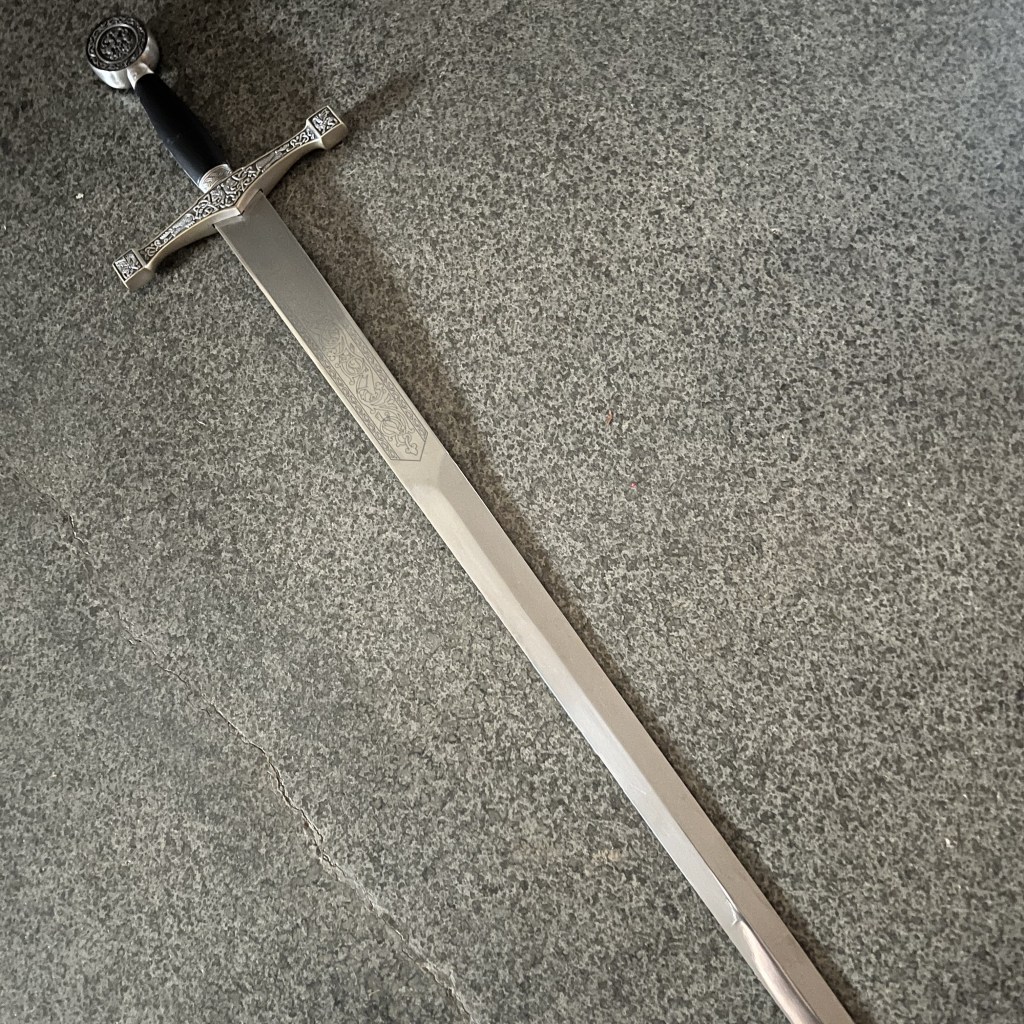
A sword named Caliburn that had been forged in Avalon, and
A spear called Ron.

Geoffrey has gotten the names of Arthur’s weapons from Welsh tradition.  In the Welsh tale Culhwch and Olwen, roughly contemporaneous with Geoffrey, Arthur’s sword is Caledfwich.  His spear is Rhongomyniad.  His shield is Wynebgwrthucher, but his ship is Prydwen.

Summary

Geoffrey’s tale of Arthur started with a battle inspired by adultery and ended with a battle inspired, at least in part by adultery.  The first ended in glory, with the conception of Arthur.  The latter ended in tragedy, with his death.  Geoffrey does not focus on the morality of these acts, unlike many of the later works in the Matter of Britain.

Many of the later authors of works in the Matter of Britain would use religious themes (a Christian king defeating the pagans and bringing out a golden age) or moral themes (Arthur’s incestuous relationship with his sister leading directly to his death).    To Geoffrey, the story of Arthur is the story of the preeminence of the Britons.  As the representative of the Britons as a whole, Arthur wages war against the Saxons, Scots, Picts, Irish, Icelanders, Norse, Danes, and even the Roman Empire.  He defeats them all.  His court at Caerleon was attended by “every prince of distinction this side of Spain”.  Arthur was effectively emperor of much of Europe, the most powerful man West of Constantinople.  Geoffrey established many of the memes used in the later literature.  However, much of that literature would concentrate on principles more than power and glory.

Bibliography:
The History of the Britons (Historia Brittonum), translated by Lupack, Alan, The Camelot Project.
Geoffrey of Monmouth, The History of the Kings of Britain, translated by Lewis Thorpe, Penguin Classics, New York, 1966.
 Den of the Red Wolf