The global pandemic has had an impact on how board games are played.  Board gaming is essentially a social event, except for the minority of players who prefer solo play.  The isolation caused by the pandemic obviously made gaming in groups harder.  The amount of solo play increased, with a large proportion of games published in the past couple of years including a solo mode.  It has also increased the options available for on-line play of traditional board games.

There are currently three ways to play board games with your friends (or strangers) over the internet.  One which showed lots of promise early in the pandemic but has fallen out of favor is through a physics simulator like Tabletopia or Table Top Simulator (TTS).  The second is through the relatively new game simulator Board Game Arena (BGA).  The third is through a game-specific app, available on iOS, Android, and Windows/Mac on Steam.  Each option has advantages and disadvantages.  Well, the last two have advantages and disadvantages.  As discussed below, the physics simulators mostly have disadvantages.

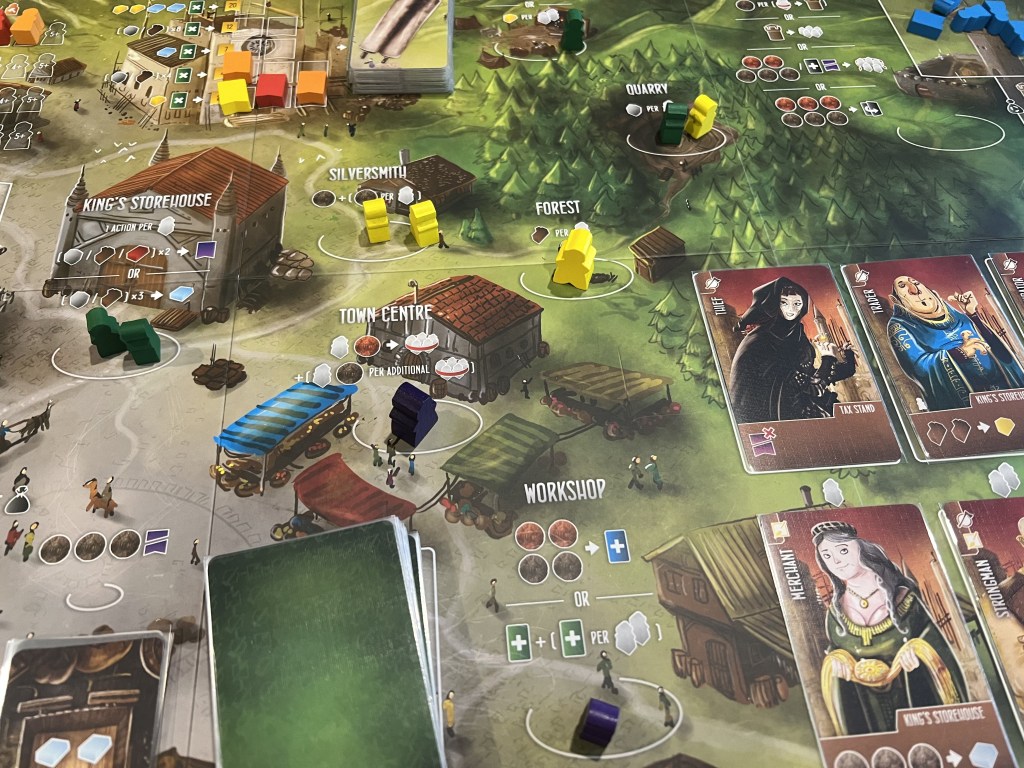
Tabletopia was the first relatively successful attempt to make a large number of board games playable on-line through one platform.  For a long time, it was the only option.  Tabletopia has a large number of licensed games you can play through a browser.  The problem is that Tabletopia is a physics simulator.  It gives you the game board, the game pieces, and a copy of the rules.  The rest is up to you.  Just like if you were playing in real life.  Its problem is that its interface cannot simulate real life.  Many games can’t fit legibly on a single screen.  A player has to pan around and zoom in and out to see everything.  There are no quick glances at your opponent’s resources.  It is also much harder to manipulate the pieces.  Trying to perform simple actions such as dealing out cards or stacking counters can be very frustrating.  For many people, the interface gets in the way of having fun.

TTS was the next physics simulator to come along.  It attempted to address some of the issues with Tabletopia.  It included a scripting system that could automate a lot of game activities.  In some cases, the scripts got close to providing the experience of a game-specific app.  Many Kickstarter board game projects started providing TTS versions to allow people to try their game out before backing a physical version.

At its heart, TTS is still a physics simulator.  It automates away some of the Tabletopia issues, but it often still clunky.  The main problems with TTS are not usability, however, but moral and ethical.  All of the games on Tabletopia are licensed from their publisher.  Most games on TTS are not.  They are created and posted by fans.  This makes TTS the Napster of board gaming.  The fan-created versions violate the publishers’ copyright.  This makes TTS the Napster of board gaming.  Publishers were loath to enforce their rights during the pandemic, wanting to give their fans an outlet.  If they fail to enforce their copyright, they will lose it.  If it doesn’t crack down on illegal games on their platform, the owners of TTS risk going the way of Napster.

And that might not be a bad thing.  It has recently been revealed that bigotry is built into TTS.  The TTS chat has long enforced a “family friendly” atmosphere.  That means no swearing or sexual content.  It also means no challenges to a heteronormative worldview.  One person in the chat identified himself as trans and was immediately banned.  He appealed to two different mods, both of whom said that the system was working as intended.

The second option for on-line board gaming is BGA.  Like Tabletopia and TTS, BGA is a platform for users to play any of a variety of games with friends or strangers.  Unlike the other two, BGA is a game simulator, not a physics simulator.  That means the gaming experience is more like a dedicated app than a physical game.  A player interacts by pointing and clicking more than trying to move each piece.  The rules are built in.  The games won’t let a player make an illegal move.  Setup and scoring are automatic.  Some games even implement a solo mode, although that mode is the same procedural mode offered in the IRL game.  AIs acting as players are not available.

Common criticisms of BGA are that the visuals for some games are pretty rough compared with, say, iOS versions of board games.  BGA also does not offer as many games as Tabletopia or TTS.  Generally, these issues reflect the relatively immaturity of BGA compared with the other platforms.  As BGA gains more users, board game publishers will have more incentive to give them a high quality experience.  More users also mean more games.  Given that Asmodee, the giant of the hobby board game industry, bought BGA a few months ago, it looks like BGA will be around for a while.

The final option for on-line gaming is game-specific apps.  There were a lot of these even before the pandemic - Lords of Waterdeep, Mystic Vale, Ticket to Ride, and Scythe to name a few.  These apps feature AIs that simulate the multiplayer experience.  Many also offer on-line multiplayer modes.  Many more have been added in the past couple of years.  The quality varies.  The UI for Viticulture, a BGG top 100 game, is almost universally panned.  The UI for Gloomhaven is phenomenal, although it does require a PC with a decent graphics card.  Generally, publishers put more time and effort into a standalone app than they would into a BGA game.  The UI quality usually reflects this.  The downsides of using apps are cost and selection.  In Tabletopia, TTS, and BGA, a user pays to access the platform (or not, there are free options).  Every game on the platform is available.  Apps have to be purchased individually, usually by everyone who will play.  In BGA, one person with a premium membership can host games for anyone.  Even though BGA doesn’t have as many games as the older platforms, it has a lot of games and adding more a lot faster than apps are coming out.

Which option should you choose?  First, forget Tabletopia and TTS.  Unless you are really experienced with the UI, they are too annoying to be fun (not even counting the other reasons you should boycott TTS).  If you are looking to have a game night experience with friends or to have a pickup game with strangers, go for BGA.  If you have a group of friends who really want to have a Gloomhaven campaign or if Scythe is your favorite game of all time, get those apps.  Many games will be quite happy with a combination of the two.
 Den of the Red Wolf